
Online D&D has evolved fast. What started as a workaround during lockdowns is now its own thriving format. Virtual tabletops are beautiful. Audio tools are cinematic. Campaign management apps are smarter than ever.
And yet… something’s always been missing.
The presence. The feeling of truly being in character. The magic that happens when imagination syncs across a group.
This guide breaks down every major element that contributes to immersion in an online game, and how to combine them into an experience that feels as real, vibrant, and emotional as sitting around a physical table.
Whether you’re a veteran DM or a new player building your first online setup, this is the definitive roadmap.
1. Start With the Foundation: A Shared Sense of Space
Online immersion begins with one question:Does your group feel like they're “together”?
At a physical table, this is automatic. Online, you have to build it intentionally.
What Creates Shared Space Online
Consistent session timing - Ritual builds atmosphere.
Dedicated gaming channels - Even simple Discord channels with pinned rules help anchor the group.
A place for character voices - Meme channels for NPC quotes, journals, GIF reactions… yes, they matter.
Humans bond through repeated cues. When your digital table has a sense of place, immersion follows naturally.
2. Upgrade Your Audio: Immersion’s Secret Weapon
Audio is the most underutilized dimension in online play.Great audio makes a game feel cinematic. Bad audio breaks immersion instantly.
Must-Have Tools
Spatial audio (Dolby.io, Sonantic, or Discord add-ons)
Soundboard apps (Syrinscape, MyNoise, Voicemod)
Noise suppression (Krisp, Nvidia Broadcast)
Why It Matters
Sound taps into primal instincts. Footsteps in a dungeon corridor. Wind during a cliff encounter. A villain’s distorted voice. Audio bypasses logic and goes straight to emotion.
If you upgrade one thing for immersion, upgrade audio.
3. Choose a VTT That Matches Your Campaign Style
Foundry. Roll20. Alchemy. Fantasy Grounds. Owlbear Rodeo.They each excel in different ways.
If you want:
Heavy tactical combat - Foundry or Roll20
Story-driven scenes - Alchemy
Simple, fast, minimal friction - Owlbear Rodeo
Deep automation & rules integration - Fantasy Grounds
Key Immersion Features to Look For
Dynamic lighting
Ambient effects
High-resolution battlemaps
Easy fog of war
Quick scene transitions
Token animations
Your VTT sets the visual tone. Pick one that aligns with the world you’re building.
4. Bring Your Character to Life With Visual Embodiment
This is the big one. Online D&D has everything except the thing players miss most:embodiment.
Webcams flatten emotion. They remind you you’re at your desk, not in a tavern.
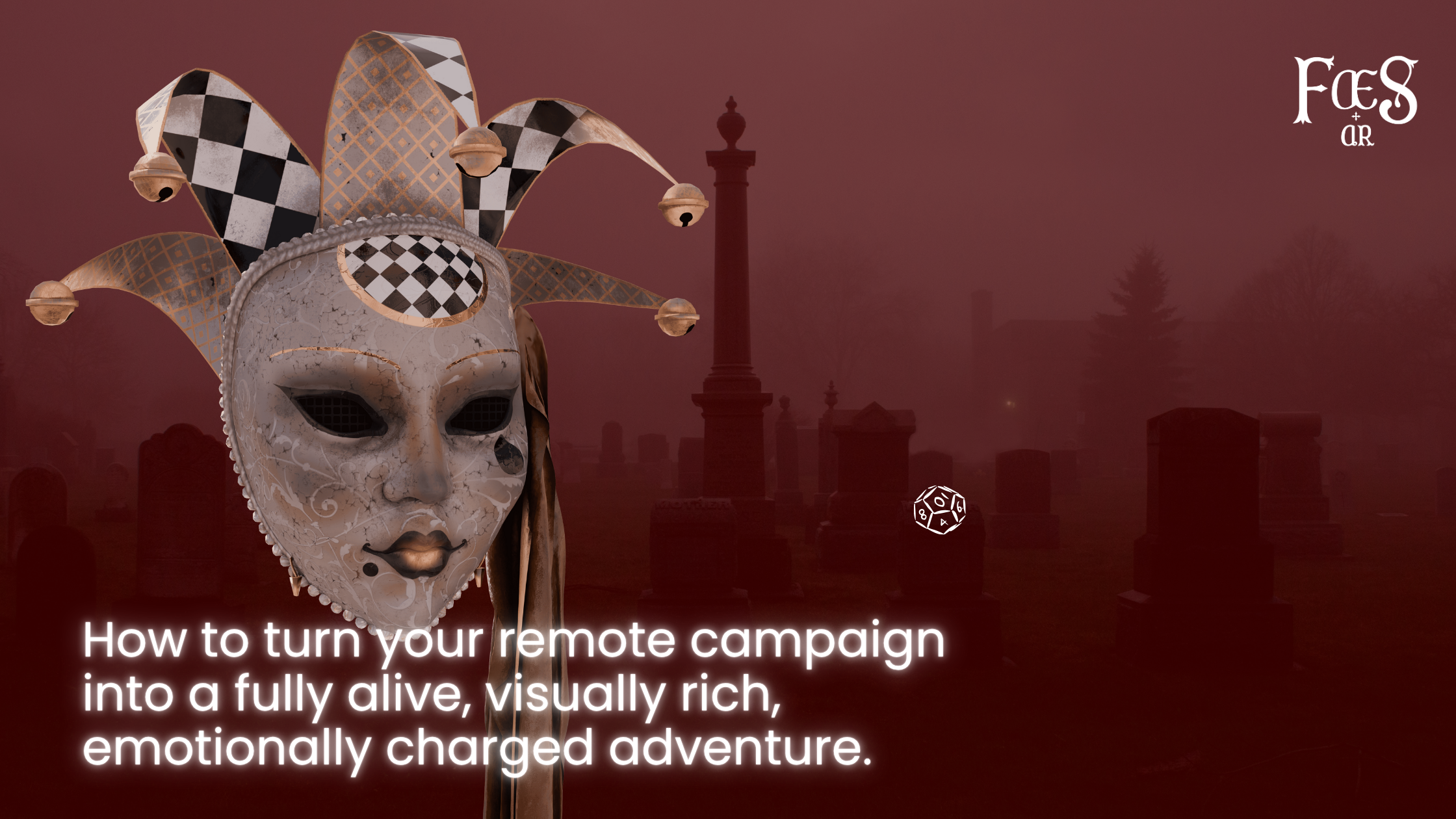
This is where Faes AR changes everything.
Why Embodiment Matters
Modern research in psychology and HCI shows:When you see yourself as your character, your behavior shifts.
Players become more expressive. GMs shift into NPCs effortlessly. Emotional beats land harder.
With Faes AR, you can:
Wear your character’s armor, horns, or magical aura
Render NPCs during dialogue scenes
Maintain immersion across Discord, OBS, and any VTT
Reduce webcam self-consciousness
Encourage quieter players to “step into” the moment
You stop pretending to be your character.You inhabit them.
This is the missing layer that finally makes online sessions feel like theatre, not conference calls.
5. Craft a Cinematic Pacing Structure
Online attention spans behave differently than in-person.Sessions feel tighter. Fatigue hits sooner. Distractions are everywhere.
Great online DMs use pacing like a director.
Use These Scene Types Wisely
Cold opens (instant tension)
Short bursts of exploration (10-12 min segments)
High-impact combats (with clear visual cues)
One spotlight moment per player
Cliffhangers tailored to webcam expressions
Good pacing keeps your world alive even when screens separate you.
6. Use Collaborative Tools to Enhance Roleplay
Want players to care more? Give them tools that make them co-authors.
Recommended Tools
Notion Campaign Hubs - for lore, maps, quests
Obsidian Shared Vaults - interconnected notes with plugins
Google Docs Journals - each character keeps a POV log
D&D Beyond + Browser Extensions - instant rule clarity
These tools turn a campaign from a weekly event into an ongoing shared world.
7. Make Combat Feel Dynamic, Not Mechanical
Combat is the most prone to “Zoom fatigue.”To keep players locked in:
Bring Energy Through Visuals
Animated maps
Spell VFX
Character-specific overlays
Enemy reveal animations
Integrate AR for NPC Dialogue
Switch to a Faes AR “NPC look” when the villain monologues.Your players will never forget it.
8. Prioritize Emotional Beats Over Rules
Your players won’t remember the AC.They’ll remember the moment your voice cracked, or the paladin’s oath echoed through the AR filter you applied.
Focus On:
Betrayals
Confessions
Nervous negotiations
Quiet campfire talks
Slow burns
Big reveals
Immersion lives in emotion, not mechanics.
9. Build Rituals That Anchor the Group
People come for the game.They stay for the rituals.
Try adding:
Pre-session “in-character warm-ups”
Recap narrated by the Bard, or by an NPC via Faes AR
A signature sound that plays when the villain appears
A “session zero reminder” every few months
A Discord channel where characters talk to each other between sessions
These touchpoints keep the story alive all week.
10. Create a Unified Visual Identity
When everything looks like it belongs to the same world, immersion skyrockets.
Unify Across Platforms
Same background vibe (forest, dungeon, void, city)
Same palette for maps
Same overlay style for OBS
Same AR theme for character appearances
Same font for handouts and NPC dialogues
Consistency creates believability.
Immersion Is a System, Not a Feature
Online D&D will never feel like “just Zoom again” when you treat it like a production.Not a rigid performance, just a thoughtful setup where every tool pushes players deeper into character.
When audio sets the mood,when visuals match the world,when pacing flows,when characters truly appear on camera …the game becomes something more than a session.
It becomes an experience.
And with tools like Faes AR, your character doesn’t just exist in the story.
They show up.